

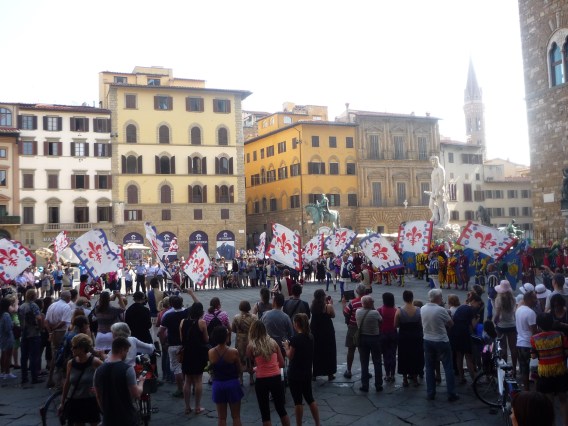
It’s a fun-filled day here in Florence with history, pageantry and spectacle! This morning started with the religious procession honoring St. John the Baptist. Beginning in Piazzetta di Parte Guelfa to the Duomo to pick up additional participants, then to Piazza Signoria by via Caiuroli. Part of the group entered the Palazzo Vecchio to pick up candles while the sbandieratori (flag-throwers) entertained the crowd with their skills outside. The Procession continued, tracing their steps back to the Duomo for the candle ceremony followed by Mass.


There’s another, larger parade this afternoon starting at 4pm at Piazza Santa Maria Novella and ending at Piazza Santa Croce. This parade includes the Calcio Storico Fiorentino (aka Florentine Football) players and is followed by the final match of 2016 at 5pm. While researching my book, Food and Folklore: A Year of Italian Festivals, the American television shown 60 minutes on CBS featured a clip on this historical and brutal sport (scroll down for a link to the clip). It’s called Calcio, the Italian word for soccer, but is it really? It looks more like a mix of soccer, football, rugby and mixed martial arts slugged out on the sand-filled square of Piazza Santa Croce
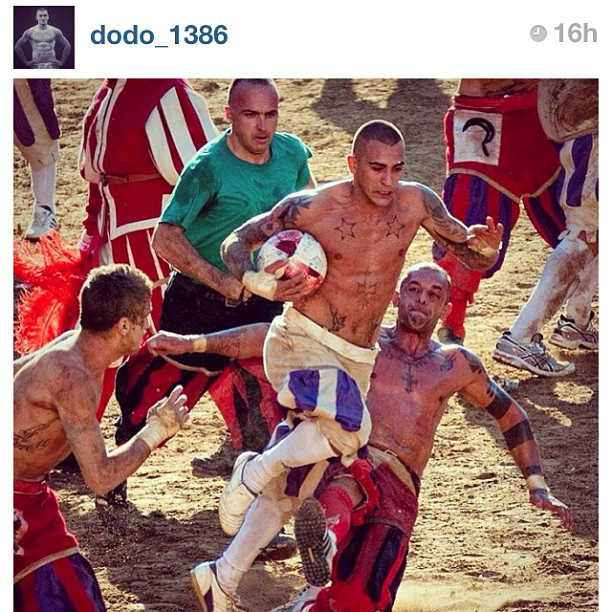 Originating in the 16th century, it was once the sport of rich nobles who played every night between Epiphany and Lent. Official rules were drafted and recorded in a Florentine court in 1580 by Giovanni de’ Bardi. Team members from four quartiere (neighborhood) in Florence take this quite seriously. The neighborhoods and their colors are:
- Blues (Azzurri) – Santa Croce
- Rossi (Reds) – Santa Maria Novella
- Whites (Bianchi) – Santo Spirito
- Greens (Verdi) – San Giovanni
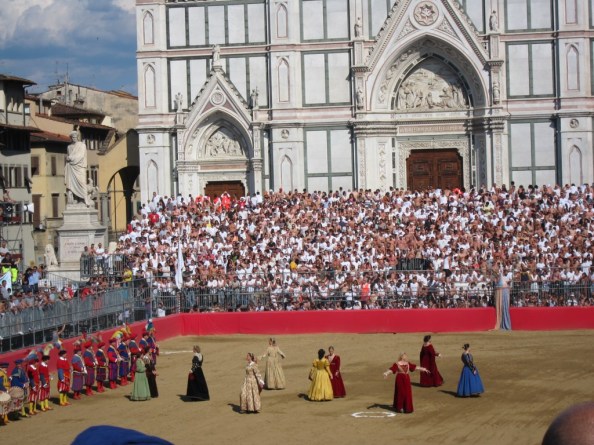 Twenty seven players on each team are half-clad in historical uniforms for the occasion. Each neighborhood is allowed to recruit players from outside the neighborhood and even outside of Italy. There are two semifinals played two weeks before the final on June 24th of each year, which coincides with St. John the Baptist day. Who plays who in the semifinals is decided Easter weekend when colored balls are drawn to determine the semi-final match ups. This year’s final (tonight) features the blues (azzurri) against the whites (bianchi). Tickets sold out in 10 minutes flat!
 Hands and feet can be used, anything goes except sucker punches and ganging up on your opponent; strictly one on one combat – and if you are kicked out – no replacements are allowed, your team plays short of members. A goal (caccia) is scored by hurling the ball over the netting at each end of the sand playing field through a narrow opening guarded by 4 goal tenders. At the end of 50 minutes, the most goals wins! What does the winning team get for their blood, guts and glory? A palio (banner) and a free dinner; in the past it was a Chianina cow. There is no monetary compensation for the winners, only bragging rights for a year. The festivities will conclude this evening at 10 pm with a spectacular fireworks show over the Arno.


A film to be released on September 16, 2016 Lost in Florence (working title was The Tourist), featuring actor Brett Dalton of the TV show Agents of S.H.I.E.L.D. He plays a college football player who joins in on the action of the Calcio Storico Fiorentino and becomes embroiled in both love and love of the sport.
Lisa M. Vogele is the author of Food & Folklore: A Year of Italian Festivals, a travel reference guide that “helps you go local” by incorporating festivals into your travel planning. You can find out more information at Lisa’s Travel Guides
IN THE NEWS
60 Minutes Video about the Calcio Storico Fiorentino
PHOTO CREDITS
All parade photos by Lisa M. Vogele
Calcio Players Romana Correale via Foter.com / CC BY-ND
Calcio Field Piazza Santa Croce alexandraalisa via Foter.com / CC BY


 The snake handlers (serpari) start gathering them in March for the May celebration. The snakes used to be housed in clay pots but are now kept in wooden boxes and fed mice and hardboiled eggs in the days leading up to the festival. There are four types of non-venomous snakes used in the procession. The statue with the snakes and its escorts are accompanied by two women dressed in traditional costumes carrying breadbaskets on their head that contain five ciambellati. Ciambellati are local, sweet, round breads that have been blessed by the parish priest and given to the escorts carrying the statue in the procession.
 Stands are set up around town to feed the thousands that have descended on the town for the spectacle. There is a fireworks display at the conclusion of the festival. Parking is quite difficult so expect to walk or be shuttled from wherever you park to the edge of town.


 lisa loves to travel